Role Shifting in Human–Robot Collaboration
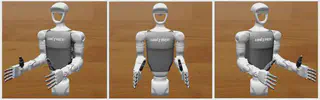 Role shifting and perspective-taking evaluation in human–robot collaboration (Fall 2025)
Role Shifting in Human–Robot Collaboration (Fall 2025) investigates embodied communication inspired by American Sign Language (ASL), utilizing torso-rotation perspective-taking behaviors on a Unitree G1 humanoid robot to improve referential clarity in collaborative handover and courier tasks.
Key Contributions
- Embodied Perspective-Taking: Implemented torso-based role shifting inspired by American Sign Language to improve gesture clarity and disambiguation in human–robot interaction.
- Comparative Human Perception Study: Evaluated gesture-only versus torso-rotation communication behaviors in user perception experiments, quantifying communicative transparency, naturalness, and trust.
- Evaluation Metrics: Designed metrics to assess clarity, naturalness, and perceived collaborative intelligence in HRI.
Research Context & Future Directions
This Fall 2025 project focused on a user perception study evaluating the efficacy of torso-based role shifting during collaborative tasks. While originally envisioned to connect temporal intent modeling (LSTMs, Transformers) directly with embodied perspective-taking, the intent recognition component has not yet been integrated into the physical robot control loop. Closing this loop—fusing real-time multi-agent intent prediction with embodied communication—remains an active future research objective.
