Role Shifting in Human–Robot Collaboration
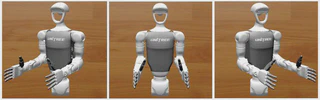 Role shifting for improved referential clarity in HRI
Role Shifting in Human–Robot Collaboration applies ASL-inspired torso-based role shifting to improve perspective and referential clarity in robot communication during collaborative tasks.
Key Contributions
Embodied Perspective-Taking: Implemented torso-based role shifting inspired by American Sign Language to improve gesture clarity and disambiguation in human–robot interaction.
Comparative Evaluation: Compared gesture-only versus torso-rotation communication behaviors on a Unitree G1 humanoid robot in a courier task scenario.
Evaluation Metrics: Designed metrics to assess clarity, naturalness, and perceived collaborative intelligence in HRI, supporting future work on interpretable and trustworthy robot communication.
Research Context
This project connects temporal intent modeling (LSTMs, Transformers) with human-centered interaction and is validated both in simulation and on collaborative robotic systems. It extends intent recognition from maritime domains to human–robot collaboration.
