Cardiovascular AI: Multimodal Imaging (IVUS/OCT & Angiography) & Agentic Decision Support
Jun 8, 2026
·
2 min read
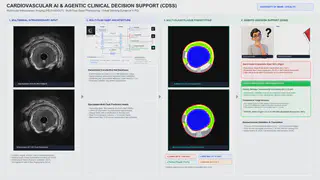 Multimodal cardiovascular analysis fusing IVUS, OCT, and Angiography within an agentic decision support pipeline
At the Center for Digital Cardiovascular Innovations, University of Miami Miller School of Medicine (directed by Dr. Yiannis S. Chatzizisis), this project develops deep learning models and clinical decision support systems (CDSS) for percutaneous coronary interventions (PCI).
Multimodal Image Analysis: IVUS, OCT & Angiography
The system combines complementary imaging modalities across scales:
- High-Definition IVUS (HD-IVUS & NIRS-IVUS): Deep multi-task ConvNeXt-U-Net networks segmenting lumen, vessel wall (external elastic membrane), and plaque composition (calcium, fibrous, fibrolipidic) across 40,000+ expert-annotated IVUS frames.
- Intracoronary Optical Coherence Tomography (OCT): High-resolution (10–15 µm) optical profiling capturing thin-cap fibroatheromas (TCFA), macrophage infiltration, and acute post-stent malapposition.
- X-Ray Coronary Angiography (Luminography & QCA): Macroscopic vessel roadmapping, bifurcation anatomy tracking, and automated co-registration with pullback cross-sections.
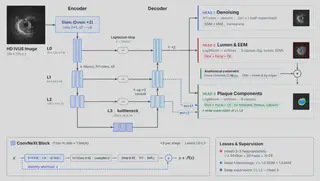
Clinical Decision Support System (CDSS)
The clinical decision support system integrates automated segmentation outputs with biomechanical simulation for procedural planning:
- Automated Calcium Phenotyping: Quantitative assessment of calcium arc, longitudinal length, and radial depth to compute standardized calcium fracture risk scores.
- Lesion Preparation Assessment: Evaluates lesion preparation strategies (non-compliant balloons, intravascular lithotripsy, rotational atherectomy) based on plaque morphology and calcification.
- Virtual Stenting Simulation: Couples finite element analysis (FEA) and learned surrogate models across 1,200 lesion phenotypes to estimate stent expansion and reduce under-expansion risks.
Related Manuscripts & Clinical Studies
- Deep Learning Model for Multi-Class Segmentation of High-Definition Intravascular Ultrasound — Under review at Scientific Reports (2026)
- Head-to-Head Comparison of Coronary Artery Bifurcation Stenting Strategies: A Virtual Clinical Study — Under review at JACC: Cardiovascular Interventions (2026)
- Head-to-Head Comparison of Latest Intracoronary Imaging Modalities — Submitted to JACC: Cardiovascular Interventions (2026)
